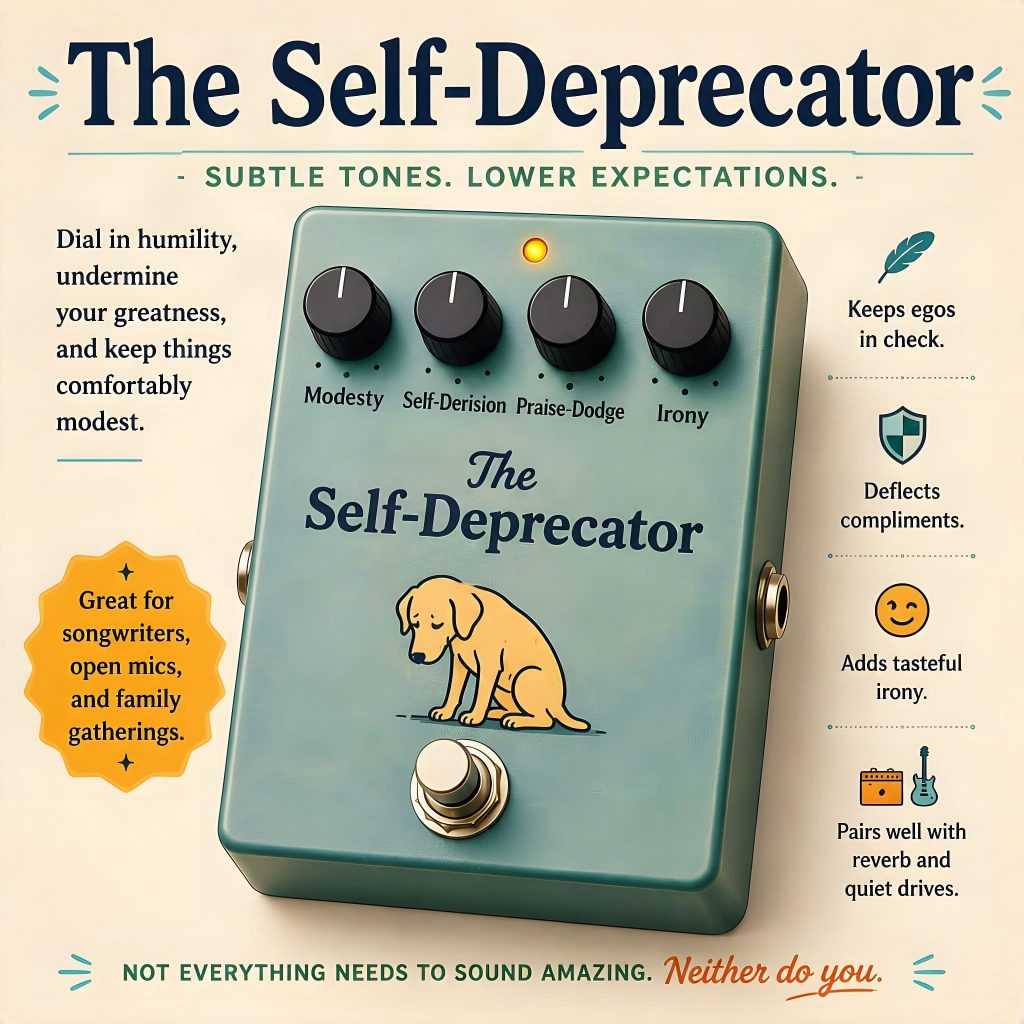
The Self-Deprecator by ImaginaryPedals
Find out more about this wonderful pedal on ImaginaryPedals.com/self-deprecator.
Weird noises, wonderful places
Of course, some pedals go far beyond tasteful enhancement. Modulation, pitch-shifting, glitchy reverbs and experimental fuzzes can pull you so far from a normal guitar sound that you forget you’re playing a guitar at all. One moment you’re strumming a chord, the next you’re piloting something that sounds like a distressed spaceship or a choir trapped inside a radio.
These sounds are not always welcome in a band setting. The drummer wants clarity, the bass player wants space, and here you are, turning your clean rhythm tone into a swarm of bees being beamed through a broken tape machine. Yet those same outlandish noises can be the key to unlocking parts of your creativity that polite tones never reach. When you don’t quite know what will happen if you turn that knob a little further, you have to listen differently, respond differently, play differently.






Getting lost in random creativity
There is a particular kind of joy in getting completely lost in a single pedal. You start with a simple idea – a riff, a chord, a scrap of melody – and then you twist a knob and it changes. You stack another pedal and the whole thing warps. Time stretches, pitch wobbles, textures smear into each other. Minutes turn into an hour and you forget whatever you sat down to practise in the first place.
These boxes can take you into realms of random creativity that feel almost generative. You’re no longer just playing; you’re collaborating with the circuitry. The pedal misbehaves slightly, reacts to your dynamics in an unexpected way, feeds back into itself, and suddenly you’re following it rather than leading. It’s both unnerving and exhilarating, like wandering into a part of your own imagination you didn’t know was there.
The strange comfort of the pedalboard
Put enough of these tiny machines together on a board and you end up with something that looks like a cross between a toy train layout and a control panel from an old science-fiction film. Cables snake between them like tracks. LEDs blink reassuringly under your feet. It is absurd, really, to need this many devices just to make a guitar go “clang” in slightly different ways. And yet there is comfort in it.
Each pedal carries a memory: the first gig where you dared to turn it on, the late night recording session where it rescued a dull part, the afternoon you spent endlessly tweaking a single sound until it was exactly, impossibly right. They are weird and wonderful, childish and serious, impractical and deeply inspiring all at once.
In the end, guitar effect pedals are more than tools. They are little boxes of nostalgia and possibility, painted in bright colours, promising – every time you click one on – that something unexpected and beautiful might happen next.
*Some come in plastic though …